28
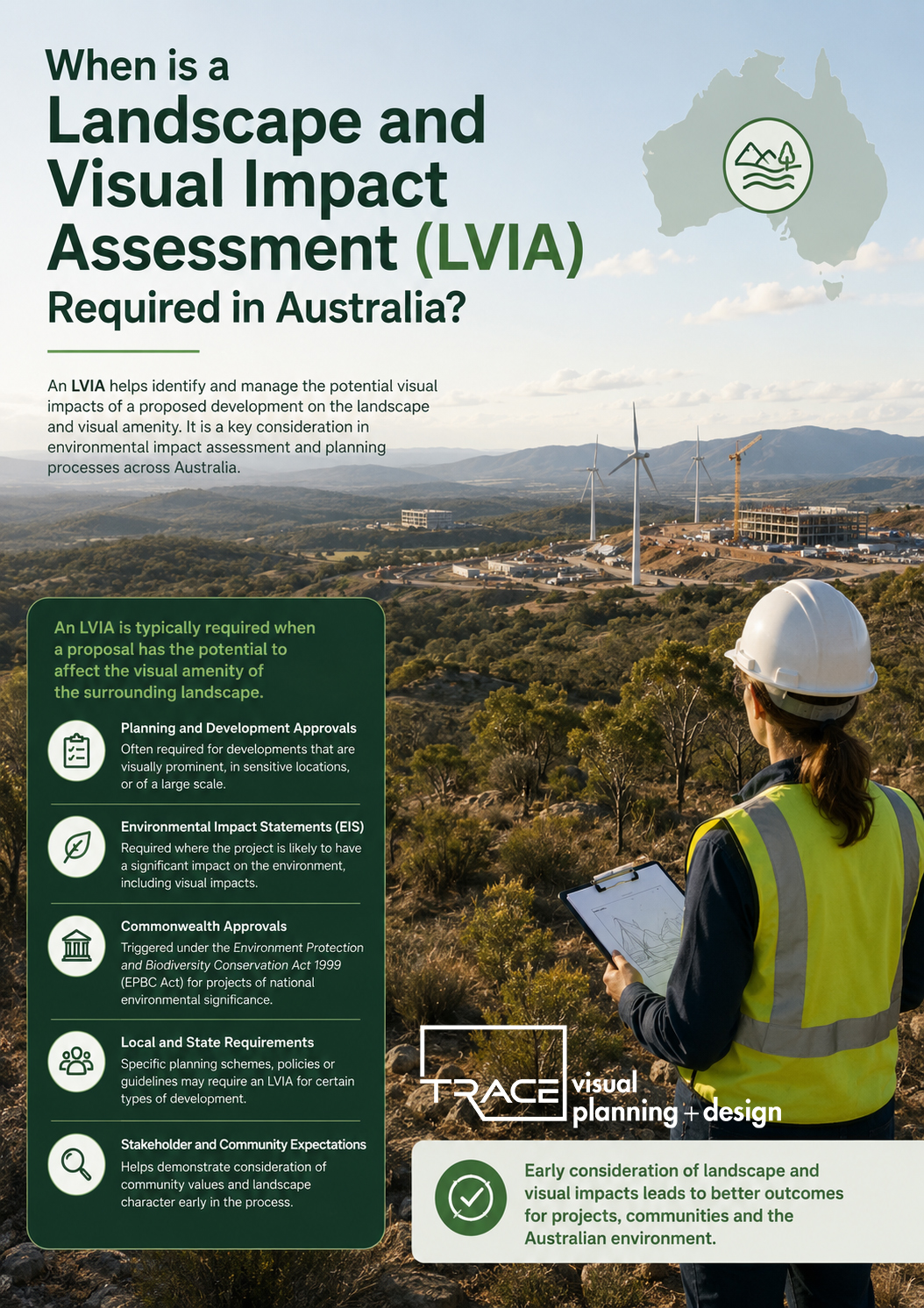
JuneWhen is a Landscape and Visual Impact Assessment (LVIA) Required in Australia?
A Landscape and Visual Impact Assessment (LVIA) is required in Australia when a proposed development has the potential to significantly alter the landscape character, visual amenity, or public views of an area.
LVIA is commonly requested as part of planning applications, environmental impact assessments (EIA), and development approvals, particularly for large-scale or visually prominent projects.
Understanding when an LVIA is required is critical for developers, consultants, and planning authorities to ensure that landscape impacts are properly identified, assessed, and managed early in the design process.
What triggers an LVIA in Australia?
An LVIA is typically required when a project is likely to cause noticeable or significant visual or landscape change. This is usually determined by planning legislation, referral agencies, or local council requirements.
Common triggers include:
- Large-scale infrastructure projects
- Renewable energy developments such as solar farms or wind farms
- Urban expansion or greenfield subdivision projects
- High-rise or visually prominent built form in sensitive areas
- Projects near coastal, rural, or scenic landscapes
- Developments within or near protected landscapes or view corridors
If a proposal is likely to be visible over a wide area or significantly change the character of a place, an LVIA is usually required.
Planning application requirements
In Australia, LVIA requirements are not always explicitly legislated at a national level. Instead, they are typically triggered through:
- State planning frameworks and environmental legislation
- Local council development application requirements
- Environmental Impact Assessment (EIA) processes
- Referral requirements from planning authorities or state agencies
For major developments, an LVIA is often included as a mandatory technical report supporting a Development Application (DA) or Environmental Impact Statement (EIS).
When councils and authorities request an LVIA
Local councils and planning authorities commonly request an LVIA when a proposal:
- Changes the skyline or built form scale in a visible location
- Affects views from public spaces, parks, or road corridors
- Is located in a designated scenic landscape or rural area
- May impact community perception of visual amenity
- Introduces industrial or infrastructure elements into natural landscapes
Councils use LVIA reports to understand whether a development will be visually acceptable and whether mitigation measures are required.
Infrastructure and major project triggers
LVIA is almost always required for major infrastructure projects such as:
- Road and highway upgrades
- Rail corridors and stations
- Bridges and transport interchanges
- Transmission lines and substations
- Renewable energy facilities (solar, wind, battery storage)
These projects often extend across large landscapes and can affect multiple visual receptors, making LVIA essential for planning approval and environmental compliance.
Renewable energy developments
Renewable energy projects are one of the most common scenarios where LVIA is required.
Wind farms, solar farms, and transmission infrastructure often trigger LVIA because they:
- Occupy large land areas
- Are visible from long distances
- Introduce new vertical or geometric elements into natural landscapes
- Can alter rural or regional landscape character
In these cases, LVIA is used to demonstrate how visual impacts are managed through siting, layout, and mitigation design.
Sensitive landscapes where LVIA is required
LVIA is strongly recommended or required in or near:
- National parks and conservation areas
- Coastal and foreshore environments
- Rural and agricultural landscapes
- Heritage landscapes or culturally significant areas
- Scenic highways and tourism routes
These landscapes typically have high visual sensitivity, meaning even small changes can have noticeable effects.
The role of LVIA in planning approval
LVIA plays a key role in helping decision-makers assess:
- Whether a proposal is visually acceptable
- How significant the landscape change will be
- Whether mitigation measures are sufficient
- How the development integrates with its surroundings
It provides a structured and defensible basis for planning decisions, helping balance development needs with landscape protection.
How LVIA is determined in practice
Whether an LVIA is required is usually determined through a combination of:
- Pre-lodgement discussions with councils or authorities
- Planning scheme requirements
- Environmental impact screening processes
- Professional advice from landscape architects or planners
In many cases, developers are advised early in the design phase to include LVIA to avoid delays in approval.
Early LVIA improves project outcomes
Engaging LVIA early in the design process can significantly improve project outcomes by:
- Reducing redesign during planning assessment
- Identifying visual constraints early
- Improving layout and siting decisions
- Strengthening approval certainty
- Supporting better community engagement outcomes
Rather than being a compliance exercise at the end of design, LVIA is increasingly used as a strategic design tool.
Conclusion
A Landscape and Visual Impact Assessment (LVIA) is required in Australia whenever a development has the potential to significantly affect landscape character or visual amenity.
While requirements vary across jurisdictions, LVIA is commonly triggered for infrastructure, renewable energy, urban development, and projects in sensitive landscapes.
By clearly understanding when LVIA is required, project teams can integrate landscape thinking early, improve design quality, and support more robust planning outcomes.