29
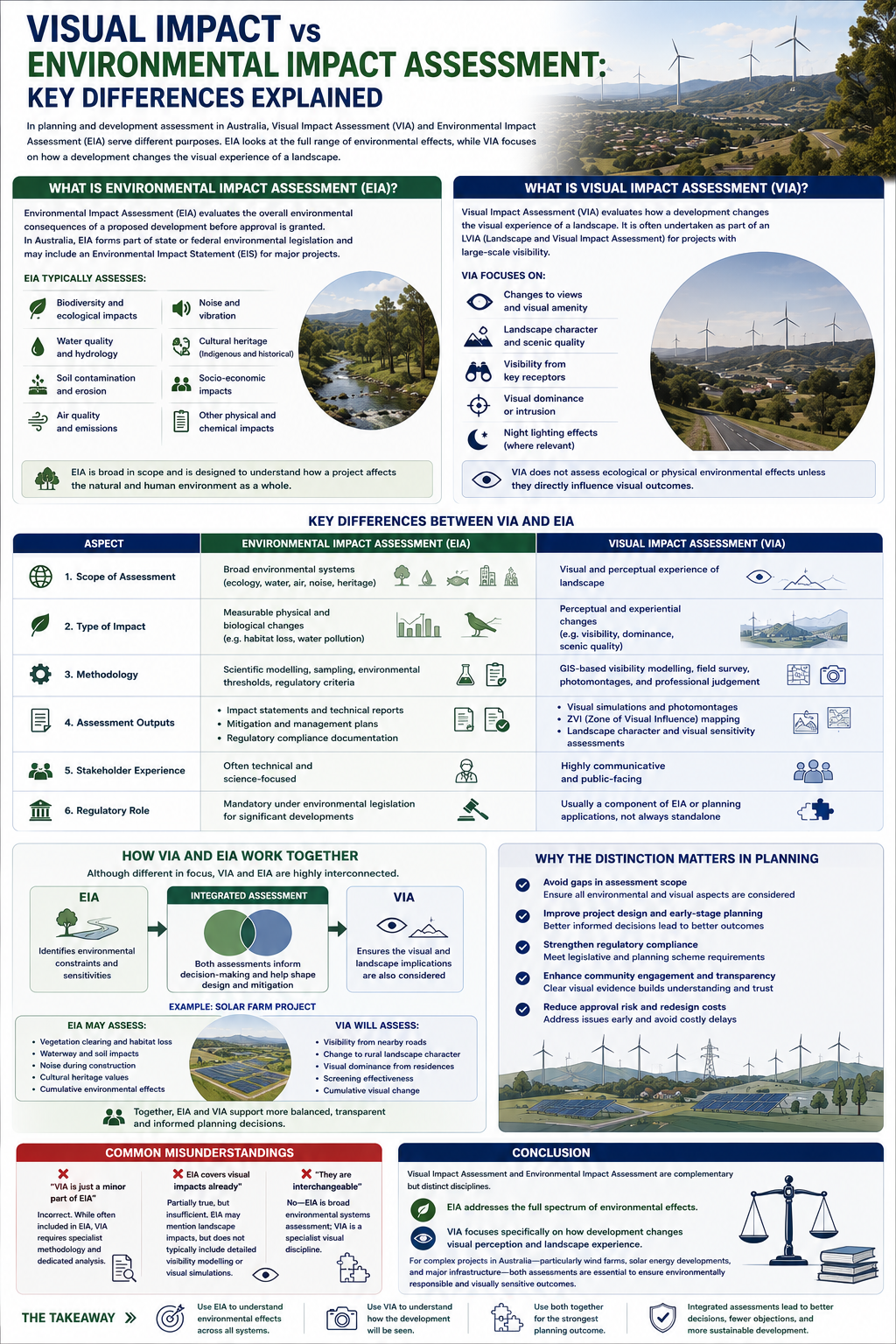
JuneVisual Impact vs Environmental Impact Assessment: Key Differences Explained
In planning and development assessment in Australia, two terms are often used together but refer to very different scopes of analysis: Visual Impact Assessment (VIA) and Environmental Impact Assessment (EIA).
While both are part of the broader planning and approval process, they focus on different dimensions of change—one centred on how a project is experienced visually, and the other on its broader ecological, physical, and socio-environmental effects.
Understanding the distinction is important for developers, consultants, planners, and decision-makers, particularly in complex projects such as renewable energy, infrastructure, and urban expansion.
What is Environmental Impact Assessment (EIA)?
Environmental Impact Assessment (EIA) is a structured process used to evaluate the overall environmental consequences of a proposed development before approval is granted.
In Australia, EIA typically forms part of state or federal environmental legislation and may include an Environmental Impact Statement (EIS) for major projects.
EIA typically assesses:
- Biodiversity and ecological impacts
- Water quality and hydrology
- Soil contamination and erosion
- Air quality and emissions
- Noise and vibration
- Cultural heritage (Indigenous and historical)
- Socio-economic impacts
EIA is broad in scope and is designed to understand how a project affects the natural and human environment as a whole.
What is Visual Impact Assessment (VIA)?
Visual Impact Assessment (VIA) is a more focused discipline that evaluates how a development changes the visual experience of a landscape.
It is often undertaken as part of an LVIA (Landscape and Visual Impact Assessment), particularly for projects with large-scale visibility such as wind farms, solar farms, transmission lines, and urban developments.
VIA focuses on:
- Changes to views and visual amenity
- Landscape character and scenic quality
- Visibility from key receptors
- Visual dominance or intrusion
- Night lighting effects (where relevant)
Unlike EIA, VIA does not assess ecological or physical environmental effects unless they directly influence visual outcomes.
Key Differences Between VIA and EIA
1. Scope of Assessment
- EIA: Broad environmental systems (ecology, water, air, noise, heritage)
- VIA: Visual and perceptual experience of landscape
EIA looks at what is affected physically, while VIA focuses on what is seen and experienced.
2. Type of Impact
- EIA: Measurable physical and biological changes
- VIA: Perceptual and experiential changes
For example:
- EIA might assess bird habitat loss
- VIA would assess how wind turbines appear in the landscape
3. Methodology
- EIA: Scientific modelling, sampling, environmental thresholds, regulatory criteria
- VIA: GIS-based visibility modelling, field survey, photomontages, and professional judgement
VIA often uses tools such as ZVI (Zone of Visual Influence) mapping and viewpoint analysis, whereas EIA relies more on ecological and technical environmental data.
4. Assessment Outputs
- EIA outputs:
- Impact statements and technical reports
- Mitigation and management plans
- Regulatory compliance documentation
- VIA outputs:
- Visual simulations and photomontages
- ZVI mapping
- Landscape character and visual sensitivity assessments
5. Stakeholder Experience
- EIA: Often technical and science-focused
- VIA: Highly communicative and public-facing
VIA outputs are frequently used in community consultation because they are visually intuitive and easier to interpret.
6. Regulatory Role
- EIA: Mandatory under environmental legislation for significant developments
- VIA: Usually a component of EIA or planning applications, not always standalone
In many Australian projects, VIA is embedded within a broader EIS process.
How VIA and EIA Work Together
Although different in focus, VIA and EIA are highly interconnected.
A well-prepared assessment process integrates both:
- EIA identifies environmental constraints and sensitivities
- VIA ensures the visual and landscape implications are also considered
For example:
- A solar farm EIA may address vegetation clearing and biodiversity loss
- The VIA will assess how the same solar farm changes rural landscape character and visibility from nearby communities
Together, they support more balanced and informed decision-making.
Why the Distinction Matters in Planning
Understanding the difference between VIA and EIA helps to:
- Avoid gaps in assessment scope
- Improve project design and early-stage planning
- Strengthen regulatory compliance
- Enhance community engagement and transparency
- Reduce approval risk and redesign costs
In practice, many project delays occur when visual impacts are underestimated within broader environmental reporting.
Common Misunderstandings
“VIA is just a minor part of EIA”
Incorrect. While often included in EIA, VIA requires specialist methodology and dedicated analysis.
“EIA covers visual impacts already”
Partially true, but insufficient. EIA may mention landscape impacts, but does not typically include detailed visibility modelling or visual simulations.
“They are interchangeable”
No—EIA is broad environmental systems assessment; VIA is a specialist visual discipline.
Conclusion
Visual Impact Assessment and Environmental Impact Assessment are complementary but distinct disciplines. EIA addresses the full spectrum of environmental effects, while VIA focuses specifically on how development changes visual perception and landscape experience.
For complex projects in Australia—particularly wind farms, solar energy developments, and major infrastructure—both assessments are essential to ensure environmentally responsible and visually sensitive outcomes.