28
JuneHiring a visual planning consultant: 7 questions to ask
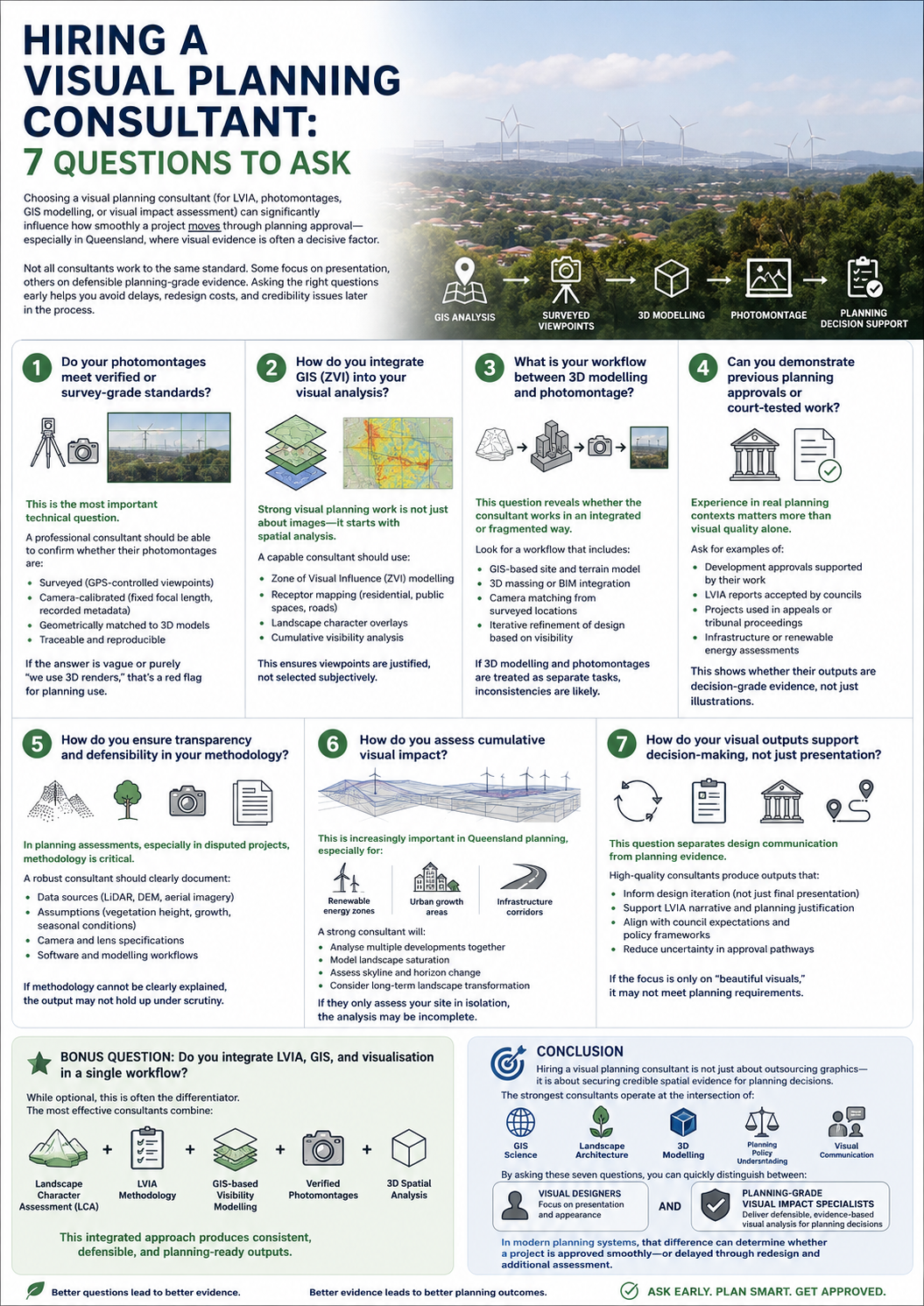
Choosing a visual planning consultant (for LVIA, photomontages, GIS modelling, or visual impact assessment) can significantly influence how smoothly a project moves through planning approval, especially in Queensland where visual evidence is often a decisive factor.
Not all consultants work to the same standard. Some focus on presentation, others on defensible planning-grade evidence. Asking the right questions early helps you avoid delays, redesign costs, and credibility issues later in the process.
Here are 7 essential questions to ask before hiring a visual planning consultant.
1. Do your photomontages meet verified or survey-grade standards?
This is the most important technical question.
A professional consultant should be able to confirm whether their photomontages are:
- Surveyed (GPS-controlled viewpoints)
- Camera-calibrated (fixed focal length, recorded metadata)
- Geometrically matched to 3D models
- Traceable and reproducible
If the answer is vague or purely “we use 3D renders,” that’s a red flag for planning use.
2. How do you integrate GIS (ZVI) into your visual analysis?
Strong visual planning work is not just about images—it starts with spatial analysis.
A capable consultant should use:
- Zone of Visual Influence (ZVI) modelling
- Receptor mapping (residential, public spaces, roads)
- Landscape character overlays
- Cumulative visibility analysis
This ensures viewpoints are justified, not selected subjectively.
3. What is your workflow between 3D modelling and photomontage?
This question reveals whether the consultant works in an integrated or fragmented way.
Look for a workflow that includes:
- GIS-based site and terrain model
- 3D massing or BIM integration
- Camera matching from surveyed locations
- Iterative refinement of design based on visibility
If 3D modelling and photomontages are treated as separate tasks, inconsistencies are likely.
4. Can you demonstrate previous planning approvals or court-tested work?
Experience in real planning contexts matters more than visual quality alone.
Ask for examples of:
- Development approvals supported by their work
- LVIA reports accepted by councils
- Projects used in appeals or tribunal proceedings
- Infrastructure or renewable energy assessments
This shows whether their outputs are decision-grade evidence, not just illustrations.
5. How do you ensure transparency and defensibility in your methodology?
In planning assessments, especially in disputed projects, methodology is critical.
A robust consultant should clearly document:
- Data sources (LiDAR, DEM, aerial imagery)
- Assumptions (vegetation height, growth, seasonal conditions)
- Camera and lens specifications
- Software and modelling workflows
If methodology cannot be clearly explained, the output may not hold up under scrutiny.
6. How do you assess cumulative visual impact?
This is increasingly important in Queensland planning, especially for:
- Renewable energy zones
- Urban growth areas
- Infrastructure corridors
A strong consultant will:
- Analyse multiple developments together
- Model landscape saturation
- Assess skyline and horizon change
- Consider long-term landscape transformation
If they only assess your site in isolation, the analysis may be incomplete.
7. How do your visual outputs support decision-making, not just presentation?
This question separates design communication from planning evidence.
High-quality consultants produce outputs that:
- Inform design iteration (not just final presentation)
- Support LVIA narrative and planning justification
- Align with council expectations and policy frameworks
- Reduce uncertainty in approval pathways
If the focus is only on “beautiful visuals,” it may not meet planning requirements.
Bonus Question: Do you integrate LVIA, GIS, and visualisation in a single workflow?
While optional, this is often the differentiator.
The most effective consultants combine:
- Landscape Character Assessment (LCA)
- LVIA methodology
- GIS-based visibility modelling
- Verified photomontages
- 3D spatial analysis
This integrated approach produces consistent, defensible, and planning-ready outputs.
Conclusion
Hiring a visual planning consultant is not just about outsourcing graphics—it is about securing credible spatial evidence for planning decisions.
The strongest consultants operate at the intersection of:
- GIS science
- Landscape architecture
- 3D modelling
- Planning policy understanding
- Visual communication
By asking these seven questions, you can quickly distinguish between:
- visual designers, and
- planning-grade visual impact specialists
In modern planning systems, that difference can determine whether a project is approved smoothly—or delayed through redesign and additional assessment.