01
JulyWhat Is Glint and Glare Assessment? Its Relevance to Visual Impact Assessment and Which Should Be Done First
Introduction
As renewable energy, commercial buildings, and major infrastructure projects continue to expand, environmental assessments have become an essential part of the planning and approval process. Among the studies commonly required are Glint and Glare Assessment (GGA) and Visual Impact Assessment (VIA). While both evaluate how a development may affect surrounding communities, they examine different aspects of visual effects and are often misunderstood as being interchangeable.
Understanding the purpose of each assessment, their relationship, and the appropriate sequence for undertaking them is important for developers, planners, environmental consultants, and regulatory authorities. This article explains what a Glint and Glare Assessment is, why it is relevant to a Visual Impact Assessment, and whether one assessment should be completed before the other.
What Is a Glint and Glare Assessment?
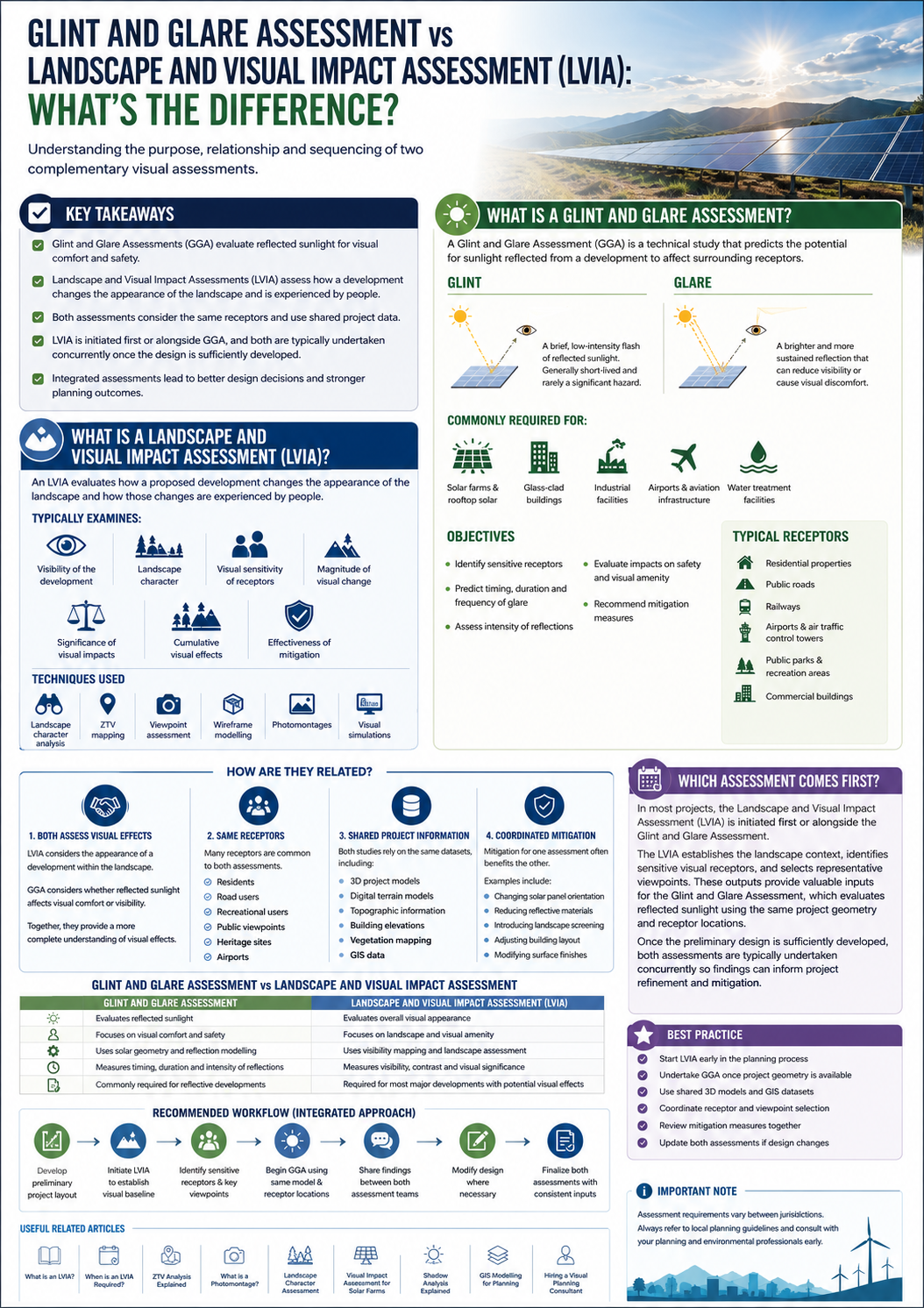
A Glint and Glare Assessment (GGA) is a technical study that evaluates the potential for sunlight reflected from a proposed development to affect surrounding receptors. It predicts when reflected sunlight may occur, how long it will last, how intense it may be, and whether it could cause nuisance or safety concerns.
The assessment is commonly required for developments that incorporate reflective surfaces, including:
- Solar photovoltaic (PV) farms
- Rooftop solar installations
- Glass-clad commercial buildings
- Industrial facilities with metallic roofs
- Airports and aviation-related infrastructure
- Water treatment facilities and reservoirs
Glint vs. Glare
Although often mentioned together, glint and glare describe different types of reflected sunlight.
- Glint is a brief, low-intensity flash of reflected sunlight. It is generally short-lived and may cause temporary distraction but rarely presents a significant hazard.
- Glare is a brighter and more sustained reflection that can reduce visibility or cause visual discomfort. In sensitive environments such as airports, highways, or railway corridors, glare can become a safety issue.
Modern assessment software models the sun’s position throughout the year to predict where and when these reflections may occur.
Objectives of a Glint and Glare Assessment
A Glint and Glare Assessment aims to:
- Identify sensitive receptors that may experience reflected sunlight.
- Predict the timing, duration, and frequency of glare events.
- Assess the intensity of reflected sunlight.
- Evaluate potential impacts on public safety and visual amenity.
- Recommend mitigation measures where necessary.
Typical receptors include:
- Residential properties
- Public roads
- Railways
- Airports and air traffic control towers
- Public parks
- Recreational areas
- Commercial buildings
What Is a Visual Impact Assessment?
A Visual Impact Assessment (VIA) evaluates how a proposed development changes the appearance of the landscape and how those changes are experienced by people.
Unlike a Glint and Glare Assessment, which focuses specifically on reflected sunlight, a VIA considers the broader visual effects of a development.
A Visual Impact Assessment typically examines:
- Visibility of the proposed development
- Landscape character
- Visual sensitivity of receptors
- Magnitude of visual change
- Significance of visual impacts
- Cumulative visual effects
- Effectiveness of mitigation measures
The assessment uses techniques such as:
- Landscape character analysis
- Zone of Theoretical Visibility (ZTV) mapping
- Viewpoint assessment
- Wireframe modelling
- Photomontages
- Visual simulations
How Is Glint and Glare Assessment Relevant to Visual Impact Assessment?
Although they are separate technical studies, a Glint and Glare Assessment is closely related to a Visual Impact Assessment because both evaluate how people experience a proposed development.
1. Both Assess Visual Effects
A Visual Impact Assessment considers the appearance of a development within the landscape, while a Glint and Glare Assessment considers whether reflected sunlight affects visual comfort or visibility.
Together, they provide a more complete understanding of a project’s visual effects.
2. Both Assess the Same Sensitive Receptors
Many receptors are common to both assessments, including:
- Residents
- Road users
- Recreational users
- Public viewpoints
- Heritage sites
- Airports
Sharing receptor information improves consistency between assessments.
3. Shared Project Information
Both studies generally rely on the same datasets, including:
- Three-dimensional project models
- Digital terrain models
- Building elevations
- Topographic information
- Vegetation mapping
- Geographic Information System (GIS) data
Using common project information reduces duplication and improves assessment accuracy.
4. Coordinated Mitigation
Mitigation measures developed for one assessment often benefit the other.
Examples include:
- Changing solar panel orientation
- Reducing reflective materials
- Introducing landscape screening
- Adjusting building layout
- Modifying surface finishes
These design changes can simultaneously reduce visual impacts and reflected sunlight.
Differences Between a Glint and Glare Assessment and a Visual Impact Assessment
| Glint and Glare Assessment | Visual Impact Assessment |
|---|---|
| Evaluates reflected sunlight | Evaluates overall visual appearance |
| Focuses on visual comfort and safety | Focuses on landscape and visual amenity |
| Uses solar geometry and reflection modelling | Uses visibility mapping and landscape assessment |
| Measures timing, duration, and intensity of reflections | Measures visibility, contrast, and visual significance |
| Commonly required for reflective developments | Required for most major developments with potential visual effects |
Although related, neither assessment replaces the other.
Which Assessment Should Be Done First?
The Visual Impact Assessment Should Be Initiated First
In most projects, the Visual Impact Assessment is started before the Glint and Glare Assessment because it establishes the visual context of the development.
The VIA identifies:
- Key viewpoints
- Sensitive receptors
- Landscape character
- Areas of highest visual sensitivity
These findings become valuable inputs for the Glint and Glare Assessment.
For example, if the VIA identifies a scenic lookout or residential community as highly sensitive, those locations should also be evaluated for potential glare.
Should They Be Conducted Simultaneously?
Yes. Although the Visual Impact Assessment should begin first, the two assessments are most effective when undertaken in parallel once the preliminary project design is sufficiently developed.
A recommended workflow is:
- Develop the preliminary project layout.
- Initiate the Visual Impact Assessment to establish the visual baseline.
- Identify sensitive receptors and key viewpoints.
- Begin the Glint and Glare Assessment using the same project model and receptor locations.
- Share findings between both assessment teams.
- Modify the design where necessary.
- Finalize both assessments using consistent assumptions and mitigation measures.
This integrated approach reduces duplication, improves efficiency, and produces more consistent results.
Best Practice for Developers and Environmental Consultants
For projects involving solar farms, reflective buildings, or other developments with highly reflective surfaces, best practice includes:
- Starting the Visual Impact Assessment early during project planning.
- Undertaking the Glint and Glare Assessment once the project geometry is available.
- Using shared digital models and GIS datasets.
- Coordinating viewpoint selection and receptor identification.
- Reviewing mitigation measures together before finalising project design.
- Updating both assessments if significant design changes occur.
Frequently Asked Questions
Is a Glint and Glare Assessment required for every project?
No. It is generally required only for developments with reflective surfaces, such as solar farms, glass buildings, or projects located near airports and transport corridors.
Can a project have low visual impact but high glare?
Yes. A relatively small glass building may blend well into its surroundings yet produce significant glare for nearby motorists or neighbouring properties.
Can a solar farm have high visual impact but low glare?
Yes. Modern solar panels are designed to absorb sunlight and typically have anti-reflective coatings, meaning they often generate minimal glare. However, a large solar farm may still have a substantial visual impact because of its size, land coverage, and contrast with the surrounding landscape.
Do Glint and Glare Assessments replace Visual Impact Assessments?
No. They address different environmental effects and are complementary studies. Many planning authorities require both assessments for projects where reflective surfaces and visual impacts are relevant.
Conclusion
A Glint and Glare Assessment evaluates the effects of reflected sunlight on surrounding receptors, focusing on visual comfort, visibility, and safety. A Visual Impact Assessment examines the broader visual effects of a development on landscapes and people. While they are distinct assessments, they are closely connected because they often assess the same receptors, use the same project data, and inform similar design mitigation measures.
For most developments, the Visual Impact Assessment should be initiated first to establish the visual baseline and identify sensitive viewpoints. Once a preliminary design is available, the Glint and Glare Assessment should be conducted concurrently, allowing both studies to share data, coordinate mitigation measures, and provide a comprehensive evaluation of visual effects. This integrated approach is widely regarded as best practice and supports more efficient planning, improved environmental outcomes, and smoother regulatory approval processes.