28
JuneScenic amenity vs landscape character: Understanding the difference
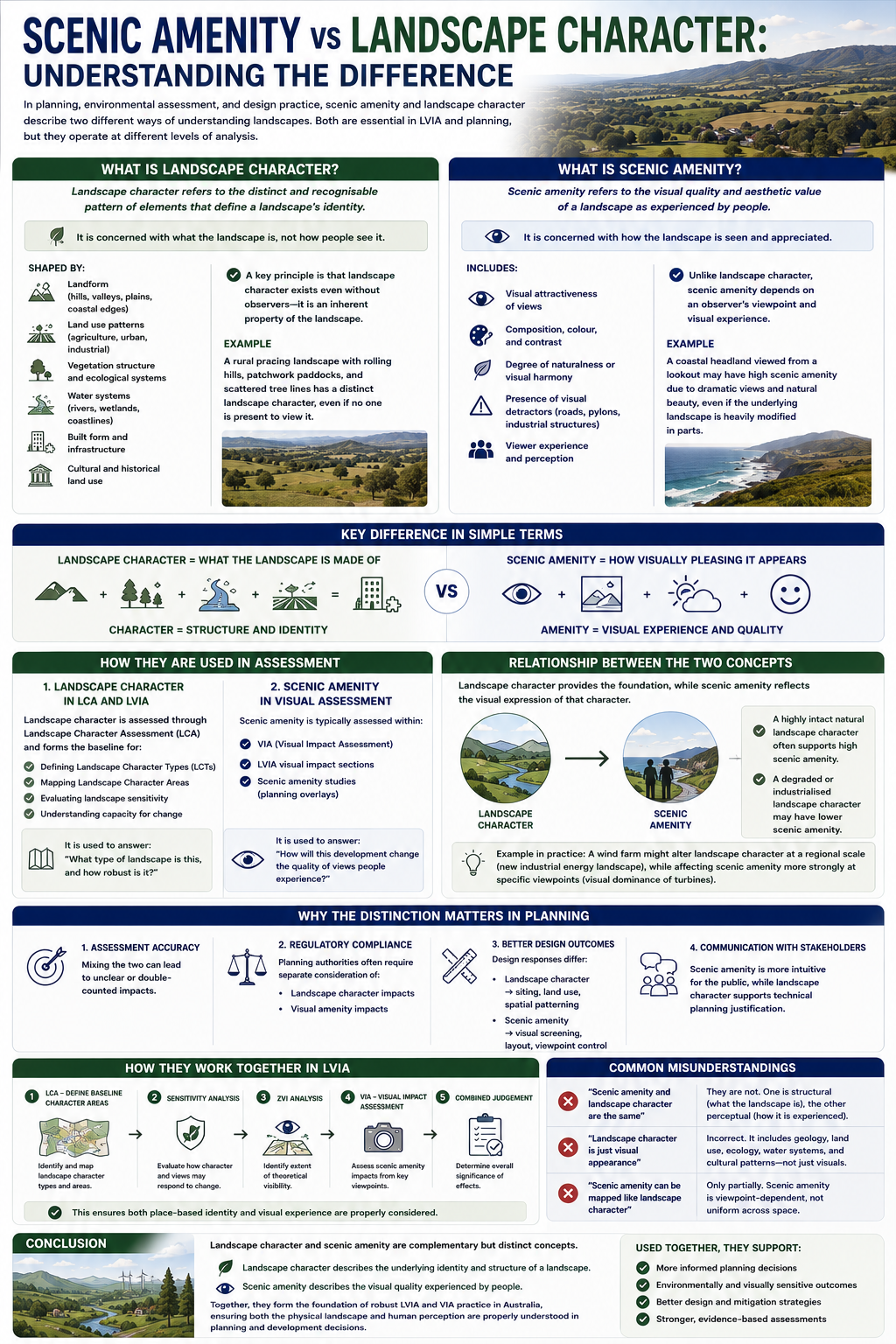
In planning, environmental assessment, and design practice, the terms scenic amenity and landscape character are often used together—but they describe two fundamentally different ways of understanding landscapes.
Confusing the two can lead to weak assessments, unclear reporting, and inconsistent decision-making. In structured processes such as LVIA (Landscape and Visual Impact Assessment), both concepts are essential, but they operate at different levels of analysis.
This article explains the difference clearly and shows how each concept is used in Australian planning and impact assessment.
What is Landscape Character?
Landscape character refers to the distinct and recognisable pattern of elements that define a landscape’s identity.
It is concerned with what the landscape is, not how people see it.
Landscape character is shaped by:
- Landform (hills, valleys, plains, coastal edges)
- Land use patterns (agriculture, urban, industrial)
- Vegetation structure and ecological systems
- Water systems (rivers, wetlands, coastlines)
- Built form and infrastructure
- Cultural and historical land use
A key principle is that landscape character exists even without observers—it is an inherent property of the landscape.
Example
A rural grazing landscape with rolling hills, patchwork paddocks, and scattered tree lines has a distinct landscape character, even if no one is present to view it.
What is Scenic Amenity?
Scenic amenity refers to the visual quality and aesthetic value of a landscape as experienced by people.
It is concerned with how the landscape is seen and appreciated.
Scenic amenity includes:
- Visual attractiveness of views
- Composition, colour, and contrast
- Degree of naturalness or visual harmony
- Presence of visual detractors (roads, pylons, industrial structures)
- Viewer experience and perception
Unlike landscape character, scenic amenity depends on an observer’s viewpoint and visual experience.
Example
A coastal headland viewed from a lookout may have high scenic amenity due to dramatic views and natural beauty, even if the underlying landscape is heavily modified in parts.
Key Difference in Simple Terms
- Landscape character = what the landscape is made of
- Scenic amenity = how visually pleasing it appears
Or more simply:
Character = structure and identity
Amenity = visual experience and quality
How They Are Used in Assessment
1. Landscape Character in LCA and LVIA
Landscape character is assessed through Landscape Character Assessment (LCA) and forms the baseline for:
- Defining Landscape Character Types (LCTs)
- Mapping Landscape Character Areas
- Evaluating landscape sensitivity
- Understanding capacity for change
It is used to answer:
“What type of landscape is this, and how robust is it?”
2. Scenic Amenity in Visual Assessment
Scenic amenity is typically assessed within:
- VIA (Visual Impact Assessment)
- LVIA visual impact sections
- Scenic amenity studies (planning overlays)
It is used to answer:
“How will this development change the quality of views people experience?”
Relationship Between the Two Concepts
Although different, scenic amenity and landscape character are closely linked.
Landscape character provides the foundation, while scenic amenity reflects the visual expression of that character.
For example:
- A highly intact natural landscape character often supports high scenic amenity
- A degraded or industrialised landscape character may have lower scenic amenity
- However, exceptions exist depending on viewpoint and perception
Example in Practice
A wind farm might:
- Alter landscape character at a regional scale (new industrial energy landscape)
- Affect scenic amenity more strongly at specific viewpoints (visual dominance of turbines)
Why the Distinction Matters in Planning
Understanding the difference is critical because it affects:
1. Assessment Accuracy
Mixing the two can lead to unclear or double-counted impacts.
2. Regulatory Compliance
Planning authorities often require separate consideration of:
- Landscape character impacts
- Visual amenity impacts
3. Better Design Outcomes
Design responses differ:
- Landscape character → siting, land use, spatial patterning
- Scenic amenity → visual screening, layout, viewpoint control
4. Communication with Stakeholders
Scenic amenity is more intuitive for the public, while landscape character supports technical planning justification.
How They Work Together in LVIA
In a structured LVIA methodology, both concepts are integrated:
- Landscape Character Assessment (LCA) defines baseline character areas
- Sensitivity analysis evaluates how character and views may respond to change
- ZVI (Zone of Visual Influence) identifies visibility extent
- VIA (Visual Impact Assessment) evaluates scenic amenity impacts from key viewpoints
- Combined judgement determines overall significance of effects
This ensures both place-based identity and visual experience are properly considered.
Common Misunderstandings
“Scenic amenity and landscape character are the same”
They are not. One is structural, the other perceptual.
“Landscape character is just visual appearance”
Incorrect. It includes geology, land use, ecology, and cultural patterns—not just visuals.
“Scenic amenity can be mapped like landscape character”
Only partially. Scenic amenity is viewpoint-dependent, not uniform across space.
Conclusion
Landscape character and scenic amenity are complementary but distinct concepts in landscape planning and visual assessment.
- Landscape character describes the underlying identity and structure of a landscape
- Scenic amenity describes the visual quality experienced by people
Together, they form the foundation of robust LVIA and VIA practice in Australia, ensuring both the physical landscape and human perception are properly understood in planning and development decisions.